Showing posts with label scientists. Show all posts

The incredible 4,500-mile Atlantic Ocean journey of tiny turtles


The incredible 4,500-mile Atlantic Ocean journey of tiny turtles
Scientists have lifted the lid on an incredible 70-day journey that wild turtles, some younger than six months old, take for the first time.

Researchers tagged some of the smallest and youngest ever baby turtles to be tracked, revealing the epic 4,500 mile journey in the Atlantic Ocean.

The young Loggerhead turtles were monitored by satellite as they made their journey - the equivalent of travelling from London to Mumbai.


Scientists customised the 9gm tracker tags normally used for birds, making them waterproof, before gluing them onto the reptiles' shells.

Jeanette Wyneken and Kate Mansfield, from Florida Atlantic University, said they were amazed at the length of the journey made by the 17 tiny turtles.

'This is the first time turtles aged four months have ever been tagged and tracked by satellite,' said Dr Wyneken.

'Previously we have never known what these young turtles do once they leave their beach nests and swim off into the ocean.

'It was important to us that the tags did not stop them from behaving normally. Thankfully they acted as as if there was nothing attached to there backs at all.

'Seaweed is an important habitat for the turtles and they had no problem moving around it.'

Using data transmitted by the tags, the team was able to map every movement.

Dr Wyneken said: 'The turtles varied a lot in their movements, more so than we expected. They're likely doing much more than just paddling straight to the deep water and riding the current.

'We're very happy and excited by the results.'

The 17 satellite tags cost £32,000 and allowed the animals to be monitored from anywhere on the planet.
The little loggerhead turtles were captured from their Florida beach nests especially to take part the tagging project.

The hand-sized reptiles were between four and six months old when they were released 10-miles east of Palm Beach and weighed only 300 grams.

When they are between six and eight months of age they outgrow the tags which fall off into the sea.

'We're trying to protect them from harm,' said Jeanette.

'The question is one of basic natural history: where are they going? For how long and what are the risks in between?

'If you don't know where they are or what places they're visiting you don't know what areas you need to protect.

'And if you don't have this information you're gambling with the method you're using to protect them and enhance their survival.'

Funding for the project came from the University of New Hampshire's Large Pelagics Research Center, Save Our Seas Foundation, Disney Worldwide Conservation Fund, and the Florida Sea Turtle Licence Plate Grants Program.

The full results of the tracking are expected to be published later this year.


Source: Dailymail

Meet the penguin with a heart-shaped breast


Meet the penguin with a heart-shaped breast
While most of us might wear our hearts on our sleeve, this little chap shows it off in just the right place.

He is an Emperor penguin chick whose change of plumage into adulthood was brrrrrilliantly blessed by Mother Nature.

The white heart-shaped patch on his chest is a natural formation due to the moulting of his feathers.

The baby penguin is blissfully aware that not only is he the focus of a heart-warming image, but that he is also literally one in a million too.

Award-winning photographer and wildlife film-maker Sue Flood said that in the 20 years she has been taking pictures in the Arctic and Antarctic, and on more than 30 trips to the frozen plains, she had never picked up such a penguin phenomenon.


She said: 'It's the only one I have ever come across with a bib of this shape.

'I took the picture at a time when Emperor penguin chicks are gaining their adult plumage and are a mix of grey baby down and "penguin suit" colours.

'This one is one in a million and in all my time as a photographer he's the only one I have seen with a bib of this shape - when I saw it, I just couldn't believe it'.

The Emperor penguin is the tallest and heaviest of all living penguin species.

Its diet consists primarily of fish but can also include crustaceans, such as krill, and squid.

While hunting, it can remain submerged for up to 18 minutes, diving to a depth of 535m and is able to reduce its metabolism and shut down non-essential organ functions in order to do this.

The Emperor penguin is perhaps best known for the sequence of journeys adults make each year in order to mate and to feed their offspring.

The only penguin species that breeds during the Antarctic winter, it treks as many as 120 km over the ice to breeding colonies which may include thousands of individuals.

The female lays a single egg, which is incubated by the male while the female returns to the sea to feed.

Mrs Flood, who has worked on some of the BBC's most successful natural history programmes including Blue Planet and Natural World, has won a clutch of awards for her photography.

Some of her amazing pictures have now been drawn together for her first book, Cold Places, which is published later this month.

It coincides with an exhibition - Cold Places: From Pole To Pole - of 50 of her photographs at London's prestigious Getty Images Gallery.

She said: 'There are times when I question why I'm so drawn to the Poles - for instance, when camping in -40 degree temperatures, enduring the hardships of macho ice-breaker life or when my eyes won't open because my eyelashes have frozen together.

'But there is something magical about the light, the isolation and the stillness, and something inspirational about how resolute animals and people have to be to survive there.

'Yes, the Poles are cold places but they also warm the heart, as I hope my book and images show.'


Source: Dailymail

NASA scientist: Fossils of alien life on meteorite

NASA scientist: Fossils of alien life on meteorite
Living in the Bay Area, one often wonders where certain beings really came from.

And it seems that the pressure for authorities to admit that everything down here isn't exactly human increases every day.

Now an astrobiologist with NASA's Marshall Space Flight Center, Dr. Richard B. Hoover, has added to the excitement.


Hoover has spent considerable years traveling to remote places like Alaska and Siberia. There, he's collected meteorites, which he's taken back to his lab and examined.

He published his conclusions yesterday in the Journal of Cosmology, and one can only describe his findings as very, very interesting.

His conclusions came out of deep examination of CI1 carbonaceous chondrites--meteorites that you don't come across terribly often. Apparently, there are only nine of them on earth.

However, once he pored into their contents, Hoover concluded there was fossil evidence of bacterial life. Given that the meterorites came from somewhere out there and not down here, he believes that somewhere out there, there is (or was) a life form.
Indeed, his simple examination, using a scanning-electron microscope and a field emission electron-scanning microscope, told him that some of the fossil life was not all that different from the micro-organisms found on earth.

He explained to FoxNews.com: "I interpret it as indicating that life is more broadly distributed than restricted strictly to the planet earth."

Perhaps this is pulsating enough. But, for me, the true joy resides in the fact that, according to Hoover, certain of the fossilized elements weren't similar to earth life at all.

Hoover told FoxNews.com: "There are some that are just very strange and don't look like anything that I've been able to identify, and I've shown them to many other experts that have also come up stumped."

Naturally, there will be skeptics. There will be those who will want to examine for themselves every last piece of evidence. There will be those who will want to present all kinds of hypotheses to cast nets of doubt on Hoover's conclusions.

In fact, another NASA scientist has already expressed caution, telling FoxNews that claims like Hoover's have been made before and found to be mistaken. And the Journal of Cosmology itself has invited the scientific community to "write critical commentaries or to speculate about the implications" of Hoover's findings; it plans to begin publishing those responses come Monday.

Still, when a former Canadian defense minister, several U.S. Air Force pilots and even Stephen Hawking all insist that alien life is out there, perhaps this research will be one more stone cast at the naysayers.

Of course, the greatest fear still lies in the unknown. While the former Canadian defense minister, Paul Hellyer, and the U.S. pilots believe aliens are friendly beings who merely want us to mend our wanton ways, Hawking is a hawk.

He declared that aliens might truly dislike us. (Not hard, I know.)

And so our world hurtles one step closer to the potential for radical change. If only one of the alien life forms would reveal itself to us, then we all might breathe a sigh of relief and redirect our energies to a better life.

My guess, by the way, is that Charlie Sheen is not an alien life form. But there must be someone from out there already here. Jimmy Fallon? Peyton Manning? Dan Rather? I just don't know.


Source: Cnet

Ice Age Child Found in Prehistoric Alaskan Home

Ice Age Child Found in Prehistoric Alaskan Home
Cremation site hints at how first Americans lived—and where they came from.
A team works in an excavation trench at the Alaskan site where an Ice Age child's remains were found.


In what's now central Alaska, one of the first Americans—only three years old at the time—was laid to rest in a pit inside his or her house 11,500 years ago, a new excavation reveals.

The ancient home site and human remains—the oldest known in subarctic North America—provide an unprecedented glimpse into the daily lives of Ice Age Americans, scientists say.

What's more, if the remains yield usable DNA, the child could help uncover just who was living on the North American side of the land bridge that likely still connected the Americas to Asia at the time, experts added.

One thing that apparently isn't a mystery is how the child was memorialized.

"You can see that the child was laid in the pit—a fire hearth inside the house—and the fire was started on top of the child," study co-author Joel Irish said. Charred wood from the pit allowed scientists to assign a radiocarbon date to the site.

After the cremation, the child's hunter-gatherer clan apparently filled the 18-inch-deep (45-centimeter-deep) hearth with soil and abandoned the dwelling. No other artifacts exist above the fill line.

Even the new find represents only 20 percent of the child's skeleton, offering few clues as to how the child died. But what's left makes it clear that the youngster died before burial and was placed in a position of peaceful repose.
Daily Life in Ice Age Alaska

"From our perspective, the child is certainly extraordinary, but the house is also unique," said study co-author Ben Potter.

Remains of salmon, ptarmigan, ground squirrels, and other animals suggest the hearth was in use for weeks or months before it was turned into a grave, the study says.

The dwelling's floor had been dug about 11 inches (27 centimeters) into the ground. Poles may have supported walls and a roof, according to telltale stains in the sediment.

In other words, this was a home—the oldest known in Alaska.

"All of the other finds dating to this period or earlier tend to be associated with either short-term hunting camps, or workshops where people are gathering high-quality stone materials and working them into tools," said Potter, an anthropologist at the University of Alaska Fairbanks.

Anthropologist Ted Goebel, who wasn't involved in the research, agreed. "What's most exciting for me is that we finally seem to hit upon a residence site where it looks like people were actually living."

Something Fishy About Ice Age Cremation Site

Now that an Ice Age Alaskan home has been found, scientists are poised to unlock secrets of how early North Americans lived and behaved, said Goebel, of Texas A&M University's Center for the Study of the First Americans.

It's already clear the residents had a taste for salmon—the remains of about 300 of the fish were found in the pit.

In addition to remains of young ground squirrels, the salmon are among evidence that the house was a summer residence for a seminomadic people. Both animals are abundant in the warmer months.

Previous evidence of dwellings had been associated with temporary camps in areas that would have been frequented in the fall, according to the study, to be published tomorrow in the journal Science.

Located amid boreal forests along the Tanana River, the new home site "paints a much broader picture of how these peoples used all the major species in the landscape," said study co-author Potter.
"We picture these people as foragers hunting large game, like bison or elk. But the fishing element is kind of new, and it's kind of striking that there are so many fish."

The apparent seasonal pattern of hunting and fishing, Potter added, is similar to that practiced by later Alaska natives.

Human Remains to Yield DNA?

A local Native Alaskan community, the Healy Lake Tribe, has named the Ice Age child Xaasaa Cheege Ts'eniin, or Upward Sun River Mouth Child, after the native name for the site.

Several native groups are working closely with the archaeologists, and some have expressed interest in comparing their own DNA with that of the child to help paint a clearer picture of the child's ancestry and perhaps of their own.

Already, a preliminary study of the child's teeth suggests he or she is biologically affiliated with both Native Americans and with Northeast Asians.

Though the specifics are hotly debated, it's generally believed that the first Americans migrated across the long-gone Bering Strait land bridge from Siberia about 13,000 years ago.
Study co-author Irish, a bioarchaeologist at the University of Alaska Fairbanks, noted that some of the site's stone artifacts, construction style, and animal remains recall those found in today's Siberia.

They're particularly reminiscent, he said, of Siberia's Ushki Lake. At that roughly 14,000-year-old site, excavations have revealed a culture that has some parallels with later Native American cultures. Ushki is also home to the only other known burial site of this era in the vicinity of the Bering land bridge, also called Beringia.

"The Alaskan record looks much more like Siberia or the Russian Far East record than it does anything in the lower 48" U.S. states, study co-author Potter added.

(Also see "Siberian, Native American Languages Linked—A First.")

Texas A&M's Goebel, who's worked at Ushki Lake, said such similarities can be found in many cultures of the ancient north, so he doesn't consider the parallels proof that the two cultures are tied.

DNA could clear up the picture considerably, and the ancient child's remains offer an unprecedented opportunity. (Related: "First Americans Arrived Recently, Settled Pacific Coast, DNA Study Says.")

"We're really interested in using the record from Alaska to define how the first Ice Age humans crossed the Beringia land bridge," Goebel said.

"But with no [human remains] we've never been able to say who those people were, what they looked like, and how they might be related to other populations.

"Now we might be able to get our first real specific look at what an early Beringian looked like, in terms of their genetics."
Read More: Nationalgeographic

Wellcome Image Awards 2011

Wellcome Image Awards 2011

Striking microscope images nab awards

Colorful shots of a ruby-tailed wasp and a human chromosome bring mostly unseen objects to life.
Wellcome Image Awards 2011

Wellcome Images is world's leading source of ...

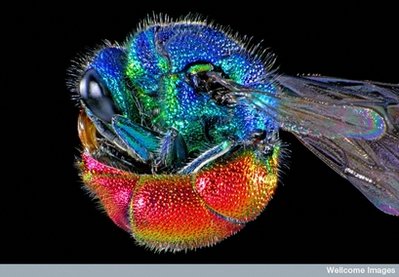
Wellcome Images is the world's leading source of images of medicine and its history. The Wellcome Image Awards recognize the creators of the most informative, striking and technically excellent images among recent acquisitions. You can view all of the 2011 winners at http://www.wellcomeimageawards.org/. This photomicrograph shows an adult ruby-tailed wasp curled into a ball. The wasp was lit with two electronic flashes while imaging to highlight the natural iridescent colours on its body.
Wellcome Image Awards 2011

Photomicrograph of a mosquito from the Culex ...

Photomicrograph of a mosquito from the Culex genus. This image shows the whole body of an adult male. The sample is from a microscope slide created in the middle of the 20th century.
Wellcome Image Awards 2011

Cell division and gene expression

Cell division and gene expression in plant cells. Confocal micrograph showing the expression of different fluorescent proteins in the stem of a thale cress seedling (Arabidopsis thaliana). Arabidopsis was the first plant to have its entire genome sequenced and is an important model for studying plant biology. The middle of the image shows a region of high cell proliferation, which drives the growth and branching of the seedling.
Wellcome Image Awards 2011

Polarised photomicrograph showing rows of suckers

Polarised photomicrograph showing the rows of suckers on the foreleg of a male diving beetle. Commonly known as the great diving beetle, these are largest freshwater beetles in the UK. They have a large streamlined body that is dark brown in colour, with a yellow abdomen and yellow legs. This image was produced by passing light through coloured filters, a technique known as Rheinberg illumination.
Wellcome Image Awards 2011

Cavefish embryo at around five days post-fertilisation. ...

Cavefish embryo at around five days post-fertilisation. The embryo has been stained with an antibody against a calcium-binding protein (in green) to show different neuronal types and their processes in the nervous system. This staining also reveals taste buds, which are located around the mouth and along the body of the cavefish.
Wellcome Image Awards 2011

Honey Bee - False colour scanning electron micrograph ...

Honey Bee - False colour scanning electron micrograph of a Honey bee. The honeybee has a hairy thorax and segented abdomen, a pair of double wings and three pairs of segmented legs, each one with a different 'tool', designed for a specific functions to assist in the collection and transport of pollen.
Wellcome Image Awards 2011

Image of human chromosome in metaphase

Image of a human chromosome in metaphase. The colours in this image indicate the density of chromatin in the chromosome, like a heat map (red shows high density, blue low). A low density of chromatin indicates a high level of gene expression, and a high density indicates repression of gene expression.
Wellcome Image Awards 2011

Moth wing scales

Moth wing scales. Scanning electron micrograph (SEM) of the scales on the wing of a Madagascan moon moth, Argema mittrei. This moth is also known as the Comet moth, after its very long tail. The tail span is 15 cm and wing span 20 cm, making it one of the world's largest silk moths.
Wellcome Image Awards 2011

This colour-enhanced photomicrograph shows different ...

This colour-enhanced photomicrograph shows different species of bacteria that cause dental plaque - a colourless film that forms on teeth caused by the growth of bacterial colonies. The sample was removed from the mouth of a patient diagnosed with an aggressive form of gum disease.

Behold the Solar Flare

On Thursday morning, you may be talking about what you watched on Wednesday night. But we're not talking about a TV show. Many parts of the U.S. could be treated to a rare but spectacular celestial event: The northern lights, the aurora borealis, may be on display. National Oceanographic and Atmospheric Administration (NOAA) forecasters estimate that there is a 45% chance of such "geomagnetic activity," according to SpaceWeather.com.
Why now? On Monday, the sun let loose its biggest solar flare in four years. NASA explains that a solar flare "occurs when magnetic energy that has built up in the solar atmosphere is suddenly released. Radiation is emitted across virtually the entire electromagnetic spectrum." NASA says that the "amount of energy released is the equivalent of millions of 100-megaton hydrogen bombs exploding at the same time."

It takes about a day or so for radiation from this flare to reach Earth's atmosphere, according to Space.com. And as the website How Stuff Works explains, the aurora borealis occurs when "when highly charged electrons from the solar wind interact with elements in the earth's atmosphere."
Web searches on "solar flare 2011" and "solar flare photos" have shot up at the speed of light. In just 24 hours, online lookups jumped 1,038% for solar flares. Folks in the northwest were particularly intrigued: Oregon, Washington, and Idaho provided some of the biggest buzz. And with good reason: States up north may have the best chance of viewing the flare's effect on Earth's atmosphere.
Read More: Yahoo